
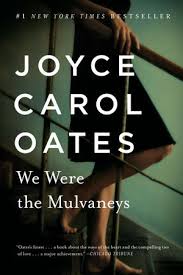
We Were the Mulvaneys by Joyce Carol Oates
Synopsis
In We Were the Mulvaneys, Joyce Carol Oates writes with piercing clarity and deep sympathy of the dissolution of the American family—and an American way of life. The Mulvaneys—parents Mike and Corinne, children Mikey Jr., Patrick, Marianne, and Judd—seemed to lead an almost charmed life on their rambling farm outside a small town in upstate New York (familiar Oates territory). Mike owned a successful roofing company; Corinne kept the semi-chaotic household bustling through the sheer force of her good humor (and devout Christianity); animals—horses, cats, dogs—thrived alongside the kids, although none was immune to the occasional scrape.
And then on Valentine’s Day in 1976, a high school senior raped the Mulvaneys’ beautiful, kind, sweet-natured daughter Marianne, and the bottom fell out of their world. Oates deftly, heartbreakingly traces the impact of the rape on each member of this family, exposing how swiftly and irrevocably good can be dragged down and corrupted into evil. The once-popular, respected Marianne becomes a kind of pariah, abandoned by her friends and pushed away by her parents. Her father, overwhelmed by grief and anger, lets the business slide, alienates former friends, and devotes himself to alcohol and law suits. Mikey Jr. distances himself from the family and from his former life by joining the Marines. Patrick, the family egg-head, at first retreats into his coldly rational fascination with Darwin and the theory of evolution, but once he’s at Cornell becomes obsessed with a scheme to avenge Marianne. With Judd, the book’s narrator, as his accomplice, Patrick stalks and abducts the boy who raped Marianne. The power of life and death is in Patrick’s hands, and yet when the crucial moment comes, he refuses to act on his power. Patrick’s act of mercy stands as an emotional and thematic turning point of the book, though the resolution is far from simple or painless.
As in previous works, Oates here covers many years and retraces the complicated, twisting paths that bring her characters to their present plight. But We Were the Mulvaneys departs from earlier works in the brilliance and vividness with which it evokes the tensions and pleasures of family life and family relationships. The Mulvaneys manage to be both “every family” and minutely realized individuals with their own quirky obsessions and personal tragedies. The book is also packed with the images and ideas of the decades it covers—the music, products, politics, social norms, and mores of the late 1950s through the early 1990s. This large, sharply etched, immensely readable book is an examination of the American dream, and of the harsh but also beautiful realities that have transformed that dream over those past four decades.
We Were the Mulvaneys is at once a rich textured novel of family life and love (including the abiding love of animals) and a profound discourse on themes of free will, evolution, gender, class, spirituality, forgiveness, and the nature and purpose of guilt. A master of her craft, Oates weaves a seamless web in which ideas blend perfectly with plot.
(From the publisher)
Purchase
Library
Not available in this library district
Reading Group Discussion Questions
- After the rape, Marianne keeps repeating, “I am as much to blame as he is.” Does the narrative back this assertion up in any way? How much does Oates actually reveal about what happened that night?
- Both parents reject their daughter after the rape. Why? How are their reasons different? Are we meant to condemn both of them for their cruelty to Marianne? Or is their action somehow understandable and forgivable?
- What role does the farm play in the life of this family? Is Oates making some larger point about the difficulties and tragedies of the family farm in American society?
- Why is it Patrick—the scientist, the cold rationalist—who acts to “execute justice” on Marianne’s rapist?
- Animals are at the heart of the Mulvaney family—they not only love their cats, dogs, birds, and horses, they love each other and communicate with each other through their animals. Is this a family strength, or does it reveal something skewed in the family emotional dynamic? Have they in a sense glorified their animals by playing up their “cuddly” loving qualities and overlooking their darker instincts? Does their connection with the animals change after Marianne is raped?
- Darwin and the theory of evolution are discussed at several points in the novel. What point is Oates trying to make with this? How does Darwinian evolution relate to the central incident of the book?
- Marianne is a Christian and Patrick is a rationalist—yet theirs is a bond that remains most intact after the rape. Are their worldviews more closely related than either of them believes? Or does the rape and its consequences somehow reconcile them not only emotionally but intellectually and spiritually as well?
- If Marianne’s rape happened today instead of in the mid-1970s, would the impact on the family and on her life have been very different? What if the Mulvaney?s lived in a big city instead of in a small town—would the rape have a different “meaning?”
- Does the novel’s ending in a joyous family reunion come as a shock after so much misery and heartbreak? Is this meant to be a lasting redemption?
- Does Oates encourage a traditional good-and-evil reading of her novel? Or does she lead us to reexamine these very categories?
(Questions issued by publishers.)
Additional Book Club Resources
Other Works by Joyce Carol Oates
Novels
- Within Arm’s Reach (2004)
- With Shuddering Fall (1964)
- Do With Me What You Will (1973)
- The Assassins: A Book of Hours (1975)
- Childwold (1976)
- Son of the Morning (1978)
- Cybele (1979)
- Unholy Loves (1979)
- Angel of Light (1981)
- Solstice (1985)
- Marya: A Life (1986)
- You Must Remember This (1987)
- American Appetites (1989)
- Because It Is Bitter, and Because It Is My Heart (1990)
- Foxfire: Confessions of a Girl Gang (1993)
- What I Lived For (1994)
- Zombie (1995)
- We Were the Mulvaneys (1996)
- Man Crazy (1997)
- Broke Heart Blues (1999)
- Blonde (2000)
- Middle Age: A Romance (2001)
- I’ll Take You There (2002)
- The Tattooed Girl (2003)
- The Falls (2004)
- Missing Mom (2005)
- Black Girl / White Girl (2006)
- The Gravedigger’s Daughter (2007)
- My Sister, My Love (2008)
- Little Bird of Heaven (2009)
- Mudwoman (2012)
- Daddy Love (2013)
- Carthage (2014)
- The Sacrifice (2015)
- Jack of Spades: A Tale of Suspense (2015)
- The Man Without a Shadow (2016)
- A Book of American Martyrs (2017)
- Hazards of Time Travel (2018)
- My Life as a Rat (2019)
- Pursuit (2019)
- Night. Sleep. Death. The Stars. (2020)
- Breathe (2021)
- Babysitter (2022)
- 48 Clues into the Disappearance of My Sister (2023)
- Butcher: A Novel (2024)
- Fox (2025)
The Wonderland Quartet
- A Garden of Earthly Delights(1967)
- Expensive People(1968)
- them(1969)
- Wonderland(1971)
The Gothic Saga
- Bellefleur(1980)
- A Bloodsmoor Romance(1982)
- Mysteries of Winterthurn(1984)
- My Heart Laid Bare(1998)
- The Accursed(2013)
As Rosamond Smith
- Lives of the Twins(1987) (U.K. title: Kindred Passions)
- Soul/Mate(1989)
- Nemesis(1990)
- Snake Eyes(1992)
- You Can’t Catch Me(1995)
- Double Delight(1997)
- Starr Bright Will Be With You Soon(1999)
- The Barrens(2001)
As Lauren Kelly
- Take Me, Take Me With You(2004)
- The Stolen Heart(2005)
- Blood Mask(2006)
Short Fiction Collections
- By the North Gate(1963)
- Upon the Sweeping Flood and Other Stories(1966)
- The Wheel of Love and Other Stories(1970)
- Marriages and Infidelities(1972)
- The Goddess and Other Women(1974)
- The Hungry Ghosts: Seven Allusive Comedies(1974)
- Where Are You Going, Where Have You Been?: Stories of Young America(1974)
- The Poisoned Kiss and Other Stories from the Portuguese(1975)
- The Seduction and Other Stories(1975)
- Crossing the Border(1976)
- Night-Side: Eighteen Tales(1977)
- All the Good People I’ve Left Behind(1979)
- A Sentimental Education(1980)
- Last Days: Stories(1984)
- Wild Saturday(1984)
- Raven’s Wing(1986)
- The Assignation(1988)
- Oates in Exile(1990)
- Heat and Other Stories(1991)
- Where Is Here?(1992)
- Where Are You Going, Where Have You Been?: Selected Early Stories(1993)
- Haunted: Tales of the Grotesque(1994)
- Demon and Other Tales(1996)
- Will You Always Love Me? And Other Stories(1996)
- The Collector of Hearts: New Tales of the Grotesque(1998)
- Faithless: Tales of Transgression(2001)
- I Am No One You Know: Stories(2004)
- The Female of the Species: Tales of Mystery and Suspense(2006)
- High Lonesome: New & Selected Stories, 1966–2006(2006)
- The Museum of Dr. Moses: Tales of Mystery and Suspense(2007)
- Wild Nights!(2008)
- Dear Husband(2009)
- Sourland: Stories(2010)
- Give Me Your Heart: Tales of Mystery and Suspense(2011)
- Black Dahlia & White Rose(2012)
- Evil Eye: Four Novellas of Love Gone Wrong(2013)
- High Crime Area: Tales of Darkness and Dread(2014)
- Lovely, Dark, Deep: Stories(2014)
- The Doll-Master and Other Tales of Terror(2016)
- DIS MEM BER and Other Stories of Mystery and Suspense(2017)
- Beautiful Days: Stories(2018)
- Night-Gaunts and Other Tales of Suspense(2018)
- The Ruins of Contracoeur and Other Presences(2021)
- The (Other) You(2021)
- Night, Neon: Tales of Mystery and Suspense(2021)
- Extenuating Circumstances: Stories of Crime and Suspense(2022)
- Zero-Sum: Stories(2023)
- Flint Kill Creek: Stories of Mystery and Suspense(2024)
- The Frenzy(2026)
If You Liked We Were The Mulvaneys:May We Recommend …
The Prince of Tides, Pat Conroy
Everything I Never Told You, Celeste Ng
Ask Again, Yes, Mary Beth Keane
The House We Grew Up In, Lisa Jewell
Commonwealth, Ann Patchett
The Most Fun We Ever Had, Claire Lombardo
The Virgin Suicides, Jeffrey Eugenides
Songs in Ordinary Time, Mary McGarry Morris
The Dutch House, Ann Patchett
We Are All Completely Beside Ourselves, Karen Joy Fowler
Links of Interest for Your Book Club Discussion
Celestial Timepiece: A Joyce Carol Oates Patchwork
A Chat with Joyce Carol Oates on The Frenzy
Commonweal, “An Interview with Joyce Carol Oates”
The Paris Review, “Joyce Carol Oates, The Art of Fiction”
Vulture, “Joyce Carol Oates Just Can’t Quit”
Steven Barclay Agency Author Page
92nd Street Y: Joyce Carol Oates in Conversation with Jonathan Safran Foer: Letters to a Biographer